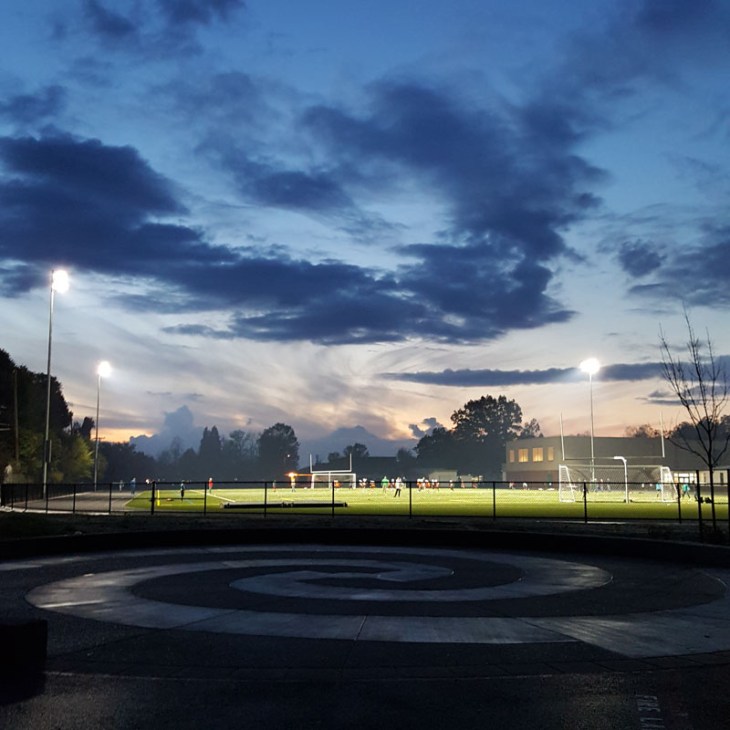
Now that it gets dark so early, Buster and I usually walk in the field behind the Howard Elementary and Kelly Middle schools instead of down at the river. Before they built the new sports facilities (not to mention the slick new buildings), we used to run around the schoolyard unimpeded by children, soccer balls, and other dog-walk-interrupting nuisances (the nerve!). While walking and grumbling I shot a few pictures, telling myself I was learning about exposure and white balance, but it turns out I’m getting really interested in the new schoolyard.
It isn’t just the uncluttered stretch of ground–rare in this suburb–open to the western sky and its amazing Oregon sunsets. Another part of it is the contrast between the battered, drafty school buildings that remain and the genuinely cool (and eco-friendly) new campus. And it’s been fun watching the Pop Warner kids throw the pigskin around in a real football field.
For someone who takes pictures to say they’re “interested in light” is about as insightful as anyone who’s alive saying they’re “interested in breathing,” but it may be that the biggest lessons I’m learning in the schoolyard have to do with light, and what qualities and circumstances make certain conditions more intriguing, more mysterious, maybe even more beautiful.
All summer long I took pictures, most of them while walking Buster on the trails along the Willamette River. Some were for fun, but most were Landscapes with a capital “L.” At the time I liked them well enough, but looking back I can see they were maybe just a little stiff, a little dull.
Then Mark and I went to Hawaii for twelve days, and something changed. Next thing I knew I was walking around Kona, taking pictures all over the place with my Galaxy Note 5. Maybe it was the relaxed pace on the Big Island, everyone in flip-flops, nobody giving me side eye for letting my hair get all frizzy in the humidity. Or maybe it was breathing in the refreshing sea air every day. Or drinking in the refreshing vodka martinis every night. Whatever it was, I didn’t feel the need to rigidly compose every shot. If something looked interesting I took a picture of it, whether I thought it would make “art” or not.
That’s how I got one of my favorite photographs, this shot of a banyan tree in downtown Kona. I walked by it three times, each time thinking its undulating trunks and silvery bark were just sumptuous, and that the amber leaves cradled in its roots were like perfect jewels adorning a lovely woman. So I finally went back and shot it, close up and without any game plan other than capturing its gorgeous texture and color.
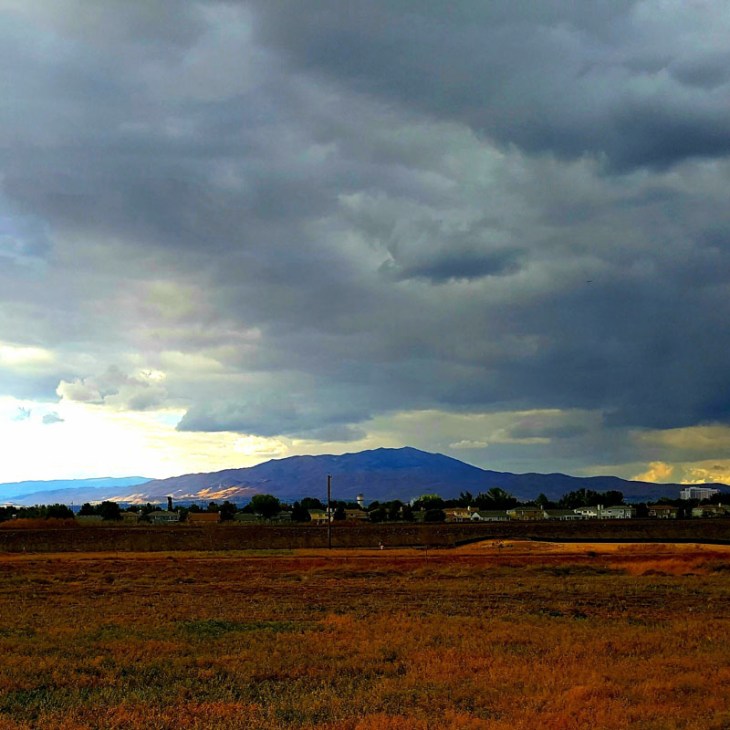
This is what I saw the last time I left Reno: a storm brewing that never quite broke. I knew life would be different, but I couldn’t see yet how different.
For now I’m taking pictures; it’s an interesting enough pursuit to be both a distraction and a kind of self-medication. It’s not the first time I’ve taken pictures. In one way or another, I’ve been making pictures most of my life. Suddenly, though, I’m interested in photographs for their own sake, not just as reference material for paintings or stories.
My first “serious” photographs — meaning photographs in which I pay attention to such photographer-ish things as exposure and saturation — are like the one above: moody landscapes, self-consciously striving for gravitas. In other words, they’re a lot like my paintings used to be.
But that seems to be changing. I don’t have a goal. I just want to keep going, and stay open to inspiration. Even if in large part because that keeps me from dwelling on the pain.
Three months ago I wrote a letter to my father introducing myself. While I wrote it I was sharply aware that, like me for most of my life, he might have never guessed that he had this genetic relationship with a complete stranger.
As first letters to parents go, it’s dry. When I sent it to my best friend for vetting, she wondered why it was so weighed down with facts: lists of names and places, detailed timelines, complicated genealogical connections. I felt I needed to submit evidence that I really was this guy’s daughter, not some nutcase who’d stalked him on the internet.
“Where’s the emotion?” she asked. “Don’t be afraid to show him your feelings.”
As if I had any idea what my feelings were.
Eight years ago, when I was 43, my mom told me I was adopted; or rather, she said she wasn’t my birth mother. The story was, as the Facebook status says, complicated. One early summer afternoon, she told me, a woman came to their house. The woman regretted to inform them that my dad had gotten her teenage daughter pregnant at a party, and that he needed to take responsibility for the child.
After my dad confessed, when the yelling and the tears had faded, and a blood test quieted their last doubts, my mom decided the whole situation was a gift from God. She’d always wanted children, but two miscarriages followed by a hysterectomy had left her without hope. Now she had the chance to raise her husband’s child. So after the woman’s daughter gave birth to me, they took me into their home and brought me up as their own, swearing never to tell anyone else—especially me—how or to whom I’d been born. As far as they were concerned, I was their child, and that was that.
Being so much older than most of my schoolmates’ parents (in my dad’s case, decades older), their brand of parental affection was brewed in an earlier time, and was fortified with a brisk shot of old-fashioned strictness. I was the kid whose mom dressed me funny: Until that magical adolescent moment when I discovered I could talk back without risking execution, she sent me to school in clothes that reminded her of her own childhood in pre-war Germany. I might as well have worn a dirndl dress, or lederhosen.
And because of my dad’s vast and decidedly unhip music collection, I grew up hearing Jimmy Dorsey and Louis Armstrong and watching The Lawrence Welk Show on our Magnavox record player/television console set. I had no idea who the Beatles were until I started middle school (for reference that was in 1975, fully half a decade after their breakup). For sure I was the only kid in my school who knew the first names of the Lennon Sisters—why, they’re the lovely Janet, Kathy, Peggy, and Dianne.
After my dad died my mom kept the secret of my birth, giving me impatient answers to my endless questions about family history, until one day she got a letter from my half-sister, someone I had no idea existed. She was the granddaughter of the woman who came to my parents’ house that day in Baltimore, and she was searching for me, her mother’s lost other daughter.
For three years my half-sister pleaded with my mom to tell me the truth. Our mutual birth mother had died of cancer, and she felt it was my right to at least know my medical history. When she finally threatened to contact me directly, my now-frail mom sat me down at her kitchen table and miserably explained it all. Central to her story was the fact that even though I was born to another woman, I was my dad’s daughter, and that she forgave him, not because she was a saint, but because she realized it was God’s way of giving her my dad’s—her husband’s—child.
But today, thanks to direct-to-consumer DNA testing, I know that I’m not my dad’s child. Whatever genes are splayed along the paternal half of my chromosomes, they didn’t come from the black-haired boiler room mechanic who played piano by ear and always wanted to be a musician. Instead my genes come from someone whose face I only know from a few fuzzy yearbook pictures I finagled by signing up on a high school alumni website under false pretenses. Maybe, I think, I can see a bit of my own too-wide, slightly-pained smile on him, this guy my birth mother had a crush on in high school.
Through the alumni site, I’ve learned a few other things: He became a Navy diver and a pentathlete, which seem like unimaginably exotic pursuits to me, a board-certified mouth-breathing dodgeball reject. From the handful of autobiographical paragraphs he wrote for his reunion, he seems articulate and smart. He’s married, and his wife has a Facebook page that I’ve poked around on, feeling a bit grubby and stalkerish for doing it. They have two chic, sporty-looking daughters, younger than me, it appears, by more than a decade. They look so little like me it was days before it hit me that they too are my half-sisters.
I’d known of this yearbook guy’s existence, and the possibility that he was my birth father, almost from the beginning. Way back when, the first time I talked to one of my uncles, he told me that none of the family at the time had ever thought my dad was my birth father. But despite my sudden interest in genealogy and DNA, I didn’t want to look.
In the first place, I wasn’t sure I believed it. Their feelings weren’t to be trusted, I thought, and especially not my birth mother’s feelings. She was blinded by love. I’d been a teenage girl myself once, and it seemed obvious to me that she’d prefer to think her baby came from the guy she’d been moony over, and not some older man, some “friend of the family’s.”
And my dad had raised me, had paid the rent and put the food on the table. Why did I need another father? I wanted to feel about my dad the way he had clearly tried to feel about me: He raised me, I was his, end of story.
Finally, I didn’t know what I would do if it were true. Certainly I could never let my mom find out; it would break her heart. And what would I want if I found him? To meet him? Just satisfy my curiosity, and if that was it, curiosity about what, exactly? I am who I am, no matter which half of my chromosomes came from whom. Aren’t I?
Other animals don’t appear to care much about who their daddies might be. Mammals in particular don’t: The very name of our biological classification comes from our dependence on our mothers as newborns. In some species, fatherhood seems to be the lethal concern only of interloping adults: If the new male in the family suspects the babies aren’t his, he kills them.
And while it’s true that among some primates, having the “right” father can confer some protective status on the infants, research in that area is turning up complications in that story.
There’s a theory that the great contribution of fathers to children comes down to sperm donation, and that the parenting part of it is almost entirely the mythology of a human socioeconomic system.1It’s the mothers who generate all the attention, get sent all the flowers, take all the blame. Even Darth Vader just missed his mom.
The knowledge that I’ll never meet my birth mother sometimes rises up, a sneaker wave, surprising me with a flood of grief and something that feels very much like despair. One day I was sweeping the floor when “Jimmy Mack” by Martha and Vandellas came on. I’ve always loved that terminally upbeat song, even though it’s half a radio-listening generation before my time. Somehow I knew that my birth mother had loved it too, and without any warning I was sobbing helplessly on the floor.
I haven’t cried over my father. Even my sadness at the displacement of my dad from my genome is more of a puzzling disappointment than a real grief, a vague sense of loss with blurry edges.
I typed the letter up in Evernote and printed it out, planning to handwrite it on nice paper, if and when I decided to send it. Right now, even as I finish this post, it’s sitting in a manila folder in my laptop bag, waiting for me to figure out how I feel.
In the days following my mom’s revelation that I was adopted, I was mostly concerned with reassuring her that I still loved her. Even now, nearly eight years after that talk at her kitchen table, I get a lump in my throat when I think of the circumstances that led to her becoming my mom, and how I’d somehow never before seen the compassion and grace that lived in her.
But naturally I spent some time reflecting on my own life, too, and I had what I thought was an insight into some of its more mysterious corners: Maybe in this secret history of my origins I could find a reason for my decades of depression; my several sincere (if incompetent) suicide attempts; my early and persistent feeling that I had been dropped from a spaceship and was just waiting for my real people to come pick me up.
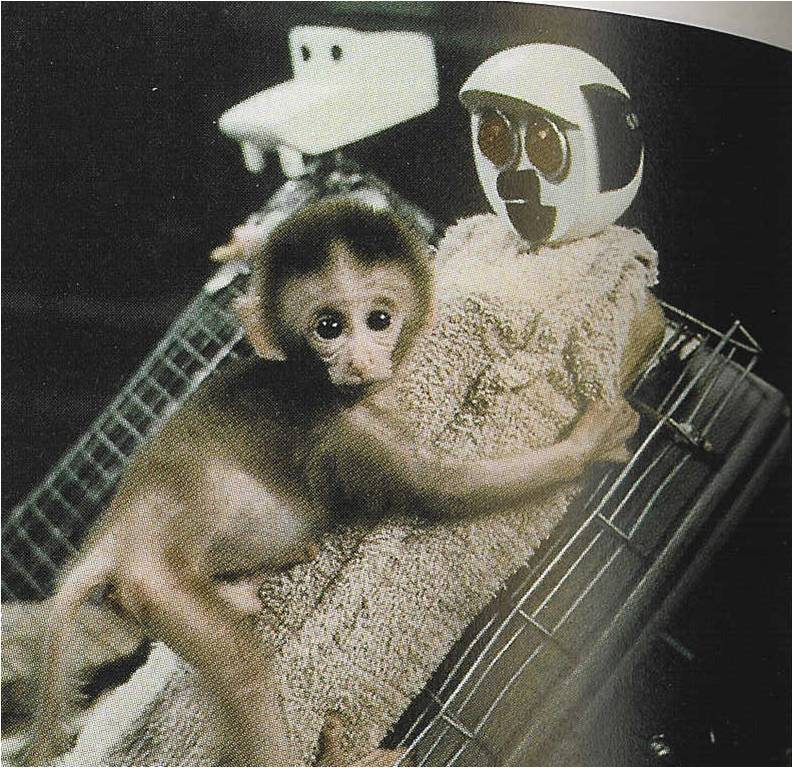
One of Harlow’s monkeys clings to its cloth “mother.”
I thought the key might lie in how an infant would perceive the sudden disappearance of her birth mother, in whose body she floated for nine months, and who held her in those raw first hours after emergence. Whose smell had probably been imprinted on some primal circuitry deep in her limbic system. Was it possible that there was some kind of neural trauma when, after many hours and days, it became clear that Mother wasn’t returning, and the newborn would have “known”–to the best of her infantile comprehension–that she was going to die?
What if, say, some hormonal cascade initiated by the terror of being abandoned were released in a mammal infant, and then, miraculously, the infant survived–would such an event leave a neurobiological signature? Then maybe there would be a scar, or even just a pathologically altered biochemical response to future events, that could explain the idiopathic seizures I had as a toddler, or the childhood asthma that kept me out of school sports (not that I yearned to participate anyway), or most of all, the depression and suicidal ideation that came with adolescence and persisted throughout much of adulthood.
On the other hand, maybe infant separation from the birth mother–in humans or in other mammals–doesn’t rise to the level of a trauma, but is just another short, unpleasant event to survive, like a vaccination or an upset stomach, quickly lost in the blooming, buzzing confusion of the infant’s new world.
There must be some research on this out there, I thought. I knew about the famous “wire mother” experiment conducted by Harry Harlow, and that the baby monkeys he took from their mothers preferred a soft, heated cloth substitute over a cold wire substitute, even when the wire contraption was equipped with a milk-dispensing bottle, and the warm cloth doll was not. In a subsequent variation, Harlow separated the monkeys and assigned them permanently to either the metal or cloth “mother.” Because the two groups of monkeys behaved differently–when terrorized, the “cloth mother” infants ran and clung to their lifeless surrogates, whereas the “metal mother” infants just collapsed where they were and screamed, or went catatonic–the study results were widely interpreted as showing that the source of nurturing was irrelevant, and that successful infant development depended on care from any warm quarter, whether birth mother or rag doll. Adoption advocates were especially pleased.
But none of the so-called “isolate” monkeys developed normally, no matter which surrogate they were assigned. As they got older, they engaged in inappropriate behaviors, were rejected by other monkeys, and acted in ways that in humans would be considered signs of depression and even sociopathy. If these socially backwards monkeys did manage to mate and have offspring–Harlow called them the “motherless mothers”–they turned out to not be much good at parenting: when they didn’t hit or bite their babies, they ignored them altogether.
So the experiment demonstrated that infant monkeys preferred warm cuddling over cold feeding, but did not remotely demonstrate that separation from the birth mother was harmless.
Of course, it didn’t show that separation itself was harmful, either. To answer that question, the experiment would have had to compare monkeys reared by their birth mothers to monkeys reared by surrogates who were also monkeys, not clothes hangers or terry cloth towels.

 Rose Nunez Smith